
On Stage- not on stage so not visible to the audience
Off Stage- on stage so visible to the audience
Wings- the sides of a theatre stage out of view from the audience
Line of Sight- a normally unobstructed line-of-sight between an intended observer (or spectator)(i.e. audience) and a stage, arena or monument.
Cyclorama- a circular picture of a 360˚ scene, viewed from inside
Back Cloth-
Trap Door- a hinged or removable panel in a floor, ceiling, or roof, usually used for surprise entrances and exits.
House Curtain- curtains at the very front of the stage
Curtain Call- the appearance of one or more performers on stage after a performance to acknowledge the audience's applause.
Fine Curtain-
Curtain Line- the line marking the position of the curtain when closed
Backstage- in or around the area behind the stage in a theatre, esp. the wings or dressing rooms.
Scenery Dock-
Bump In/Out- the process or preparing the theatre for a particular production or packing up the theatre after a production. It includes building the set, introducing props and costumes, and rigging the lights.
Calls-
Dressing Rooms- a room in which performers before, after, or during their performance.
Wardrobe Room-
Green Room- a room in the theatre in which performers can relax when they are not performing.
Showing posts with label Notes. Show all posts
Showing posts with label Notes. Show all posts
Ins and Outs of the Stage Vocabulary


Read User's Comments(0)

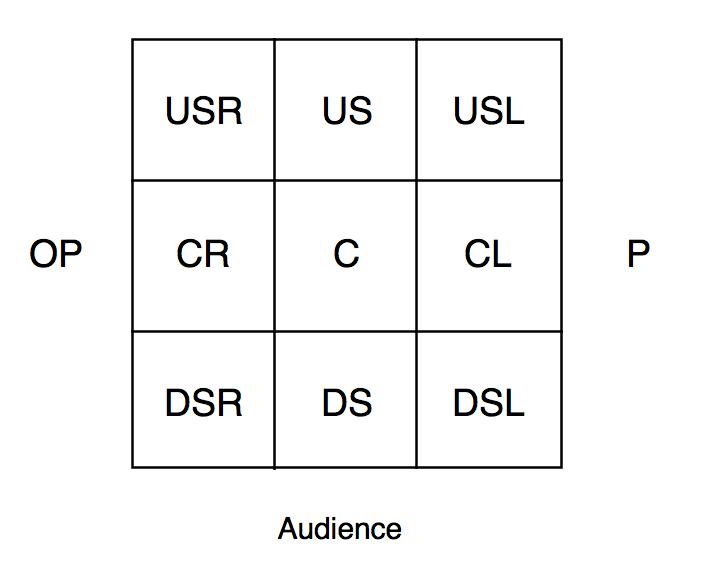
Stage Positions
- US- Upstage
- USR- Upstage Right
- USL- Upstage Left
- C- Centre
- CR- Centre Right
- CL- Centre Left
- DS- Downstage
- DSR- Downstage Right
- DSL- Downstage Left
- P- Prompt
- OP- Opposite Prompt
The Elements of Drama
- Character- the representing of a three dimensional human being with a particular personality, characteristic and background.
- Role- the representing of a point of view, and identifying with a set of values and attitudes.
- Status- a character's position and standing, weighty or otherwise, within any grouping of people; e.g. high status as opposed to low status.
- Conflict- characters are in conflict when they have opposing purposes or objectives within the drama.
- Dramatic tension- the problems faced by a character: their relationships, the creation of surprise, the unfolding of mystery.
- Focus- the performer's focus in creating concentration and belief. The audience's focus on the dramatic situation.
- Place- the setting of the dramatic action.
- Time- the period in which dramatic action takes place.
- Situation- the circumstances the characters are in
- Space- the stage area, the spatial design of the set and the arrangement of the physical elements of the performance (e.g. where the actors are placed)
- Language- the verbal and non-verbal forms in which the dramatic action is conveyed.
- Moment- the control and manipulation of key moments in the dramatic actions (e.g climax.)
- Sound- the use of aural devices to enhance the performance.
- Rhythm- the manipulation of time through pace and tempo.
- Structure- the framework through which the content of the drama is presented.
- Symbols- the visual imagery of language, movement, gesture, objects and staging used to reinforce meaning.
- Atmosphere- the feeling or mood created by, and emerging through, the dramatic action.
- Dramatic meaning- the sum total of what is communicated between the performers and the audience.
- Audience engagement- the ultimate purpose of all the elements of drama.
Types of Performance Spaces
 The Proscenium Stage
- Can use lots of scenery for "realistic" visual "picture frame"
- More realism possible
- Easier to light (from one direction)
- Room backstage
- Uses traditional stage areas (upstage, downstage)
Proscenium Stages in Sydney
- Sydney Lyric Theatre
- Everest Theatre
- Sydney Opera House
- Sydney Theatre
- Drama Theatre
Thrust and Arena Stages
The thrust stage has the main body of a Proscenium stage with an apron that allows action to be viewed from three audience perspectives.
The Arena stage is a stage that can be viewed by the audience from 360˚- this means there are no entrances and exits covered by wings, meaning that performances on Arena stages tend to shy away from realism, as the stage allows for a more abstract and unique performance style.
 |
Thrust Stage |
 |
Arena Stage |
Created/Found Spaces
These spaces utilise the environment around us to create performance spaces and can be created by modifying the environment. Created/found spaces are non-traditional- such as a basement of a building, the side of a hill, or even the street.

Subscribe to:
Posts (Atom)